See beyond the obvious. Commit with confidence.
Urchin is a scientific reasoning system that helps biopharma teams systematically explore high-stakes strategic and scientific decisions before committing resources.
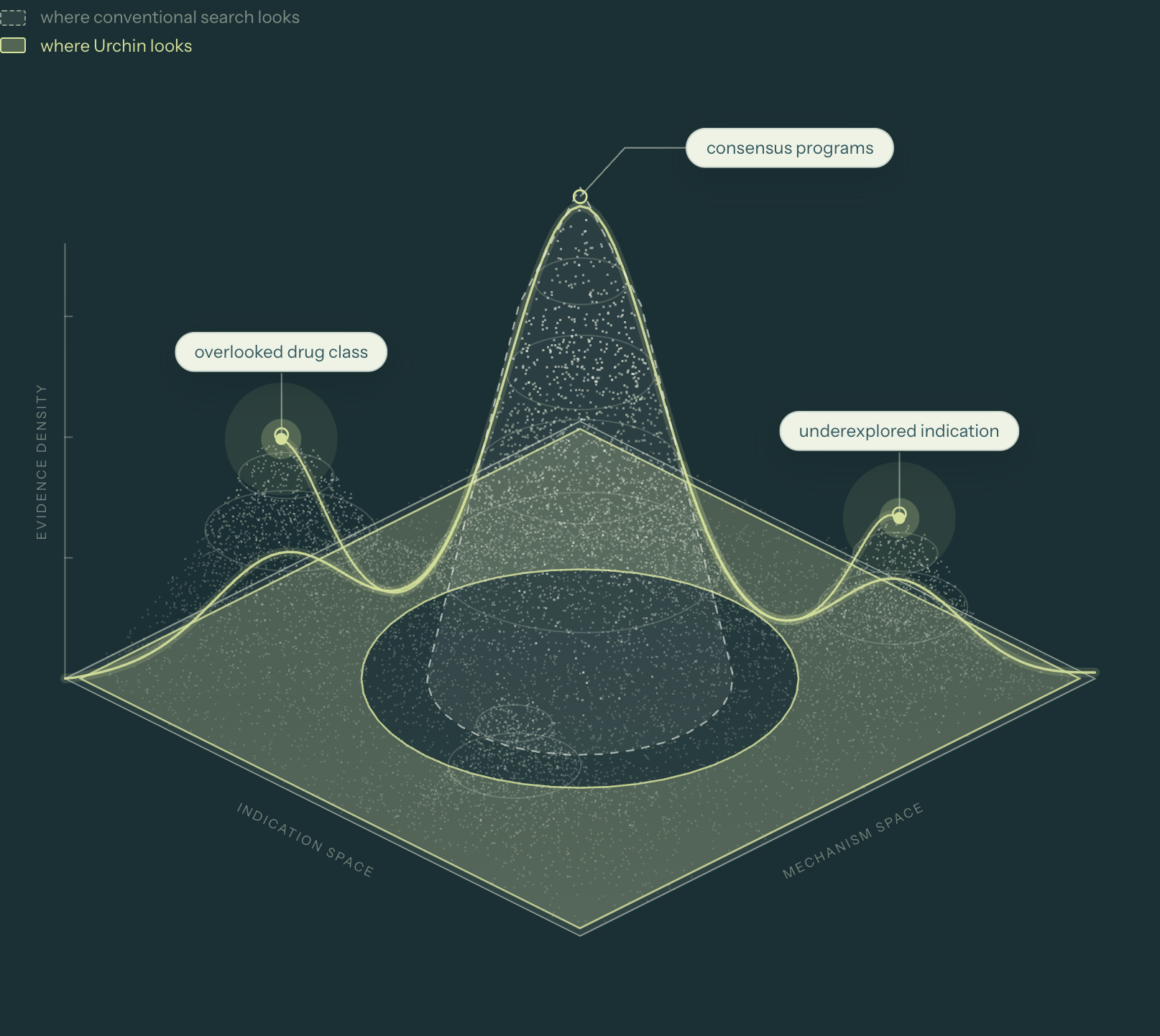
where conventional research looks
where Urchin looks
indication space
mechanism space
evidence density
consensus programs
overlooked drug class
underexplored indication
Biology is expanding what's possible faster than scientific teams can investigate it.
New modalities, advances in data generation, and AI-driven discovery are opening up more therapeutic possibilities than ever before. But the evidence needed to evaluate them is scattered across millions of publications, patents, datasets, clinical studies, and proprietary experimental data.
Even the best scientific teams can investigate only a fraction of what might matter before deciding where to focus.
Explore broadly without sacrificing depth.
Traditional research forces a tradeoff: investigate a few opportunities deeply, or screen many superficially.
Human experts provide scientific depth but can only explore a limited portion of the search space. Generative AI tools provide broad synthesis but limited depth, often converging on a small set of plausible answers.
Urchin combines scientific depth with systematic, machine-scale exploration, applying structured scientific reasoning across hundreds of possibilities and going deeper wherever the evidence points.
One reasoning process across the whole evidence landscape.
No single evidence source contains the answer. Urchin reasons across scientific, clinical, competitive, and internal evidence, revealing connections that are easy to miss when each source is considered in isolation.
- i Publications, human genetics and biological databases sit in the same reasoning process as clinical trials, biomarkers, pipeline activity, patents, therapeutic precedent, and your own experimental data.
- ii Urchin creates structured, inspectable reasoning traces your team can review, challenge, and extend. Every conclusion stays connected to its supporting evidence, keeping scientific judgment in your team's hands.
- iii Every question builds on the last, with scientific reasoning that compounds instead of resetting, preserving scientific context as new evidence emerges and programs evolve.
Hover a hypothesis or a nomination to light its path back to the sources
Illustrative trace, modeled on the SharkTooth Bio engagement.
Wherever the opportunity space is large, the evidence is scattered, and the stakes are high, Urchin can help.
Urchin applies the same reasoning framework across a wide range of scientific and strategic decisions.
Indication selectionWhere does this approach have the strongest therapeutic potential?
Biological strategyWhich mechanisms or hypotheses are most worth pursuing?
Translational strategyWhat experiments would most reduce uncertainty around this program?
Asset strategyWhere else could this asset create therapeutic value?
Portfolio strategyWhich opportunities deserve additional investment?
200+
Opportunities explored. Six new possibilities advanced to the shortlist.
Urchin systematically investigated more than 200 indications against a gene editing company's biological, technical, and commercial constraints. After three rounds of refinement, six opportunities the scientific lead had never considered were elevated to the shortlist—including one where permanent gene editing offered a distinctive therapeutic advantage.
19
Compounds selected for in vivo testing at SharkTooth Bio
Urchin integrated SharkTooth's proprietary RNA-seq data from CMT1A mouse models with public evidence, and surfaced a drug class their advisors had not originally prioritized.
- 1.6MPeople living with CMT1A worldwide, with no approved treatments
- 6Categories of output, each one feeding a decision on the program
- 1Drug class surfaced by Urchin that was not originally prioritized
4
Novel mechanistic hypotheses for Vrata Therapeutics
None of them had been considered before. Urchin explored the space of mechanistic possibilities and returned each hypothesis with a rationale and suggested experiments.
- 1 weekFrom first report to reagents ordered
- 4Hypotheses, each with suggested experiments for iterative testing in the lab
3
Iterative analyses into one clinical roadmap
A translational strategy advisor used Urchin to connect regulatory precedent, potency assay strategy and clinical design into a single evidence-based framework, which he shared with the board and KOLs.
- Phase 1-3Clinical design connected to assay strategy and mechanism
- 1Roadmap for a first-in-class therapeutic program
27
PBPK parameters estimated for Absco Therapeutics
Each estimate came with structured rationale, supporting evidence and a confidence assessment, and Urchin evaluated translational differences across nine species to clarify which preclinical models were viable.
- 9Species compared for translational differences, from mice to non-human primates and humans
- 1Mechanistic question about drug absorption resolved without running the experiment
30k
Patient immunology cohort at the center of Probably Genetic's Series B decision
Cohort expansion or richer per-patient data? Urchin connected the biology of each path to partner demand and market comparables, and the team reoriented its strategy around a depth-first approach.
- 2Growth paths modeled through to partnerships, hiring and capital allocation
- 1Follow-on engagement extending the framework to expansion beyond immunology
19SharkTooth BioCompounds selected for in vivo testing, including a drug class the advisors had not originally prioritized.Read the study
4Vrata TherapeuticsMechanistic hypotheses the team had not considered, with reagents on order within a week.Read the study
3Jonathan ThonIterative analyses that formed one clinical roadmap, shared with the board and KOLs.Read the study
200+A gene editing companyCandidate opportunities evaluated, with 6 shortlisted that were previously unconsidered.Read the study
27Absco TherapeuticsPBPK parameters estimated with rationale and confidence, and translation compared across nine species.Read the study
10xProbably GeneticThe difference in deal size discovered for a depth-first growth strategy.Read the study
How we work.
A typical first engagement takes 2 to 4 weeks and starts with a single, high-value question. Your scientists bring the context and judgment. We use Urchin to systematically explore the space around the question, integrating public evidence with your team's data and expertise. Together, we iteratively refine the search, interrogate promising hypotheses, and narrow toward the opportunities worth acting on.
A clearly defined question
Scoped collaboratively with your team, so the search starts from the decision you need to make.
A systematic opportunity map
The opportunity space mapped and prioritized, delivered through an interactive workspace.
Inspectable reasoning
Every conclusion linked back to its supporting evidence, so your team can review, challenge, and extend it.
Recommended next steps
What to do next to validate the most promising opportunities.
Founded by the product lead behind gnomAD.
Grace Tiao
Founder & CEO
Previously Associate Director, Computational Genomics at the Broad Institute of MIT and Harvard, where she led product for gnomAD, the largest public database of human genetic variation.